


Following up on our recent analysis in The Volatility Compression Dilemma and our breakdown of the Volatility Re-Bid, market dynamics took a sharp, single-track turn this week. While media commentary scrambled to make sense, as always, of mixed headline equity swings, true price discovery was happening in one asset class alone: Treasury Futures.
The Bond Rout: Multi-Decade Lows
Fixed-income futures faced relentless, structural selling pressure throughout the week as long-end yields surged, severing critical multi-year support levels:
30-Year Bond Futures (ZB): Settled the week at 106’24, after flushing down to print intra-week lows of 106’05, price levels not seen since mid-2007.
10-Year Note Futures (ZN): Touched lows of 105’290, retesting territory last seen in late 2023.
This historic drop across the Treasury curve highlights a persistent structural shift in rates, keeping duration assets heavily weighted and demanding strict capital discipline.
Adding to the macro drama, Treasury Secretary Scott Bessent tried to step in with expanded bond buybacks to rein in long-end yields, projecting a firm "I am the house now" stance to market short-sellers. Yet, as the tape clearly proved this week, the bond market swiftly rebuffed the financial engineering, sending yields higher and forcing futures to new multi-decade lows regardless. When dealing with a $30 Trillion market, it takes a whole lot more than $6 Billion and tough talk to prove you are the house.
Within our own portfolio execution, we currently hold a short ZB 108’00 put, which originated as a leg of a Put Ratio Spread previously sold. Implied Volatility across the curve reflects this ongoing pressure, with September expirations (14 DTE) holding a 10% IV and October expirations (42 DTE) sitting at 10.5% IV. Although our short 108’00 put is now ITM (in the money) following the break to 106’05, the recent volatility expansion has kept its extrinsic value significant enough that rolling the position is neither necessary nor optimal at this time. We continue to let time decay and elevated option pricing work in our favor.
CPI Confirmation: 25 bps Rate Hike Locked In
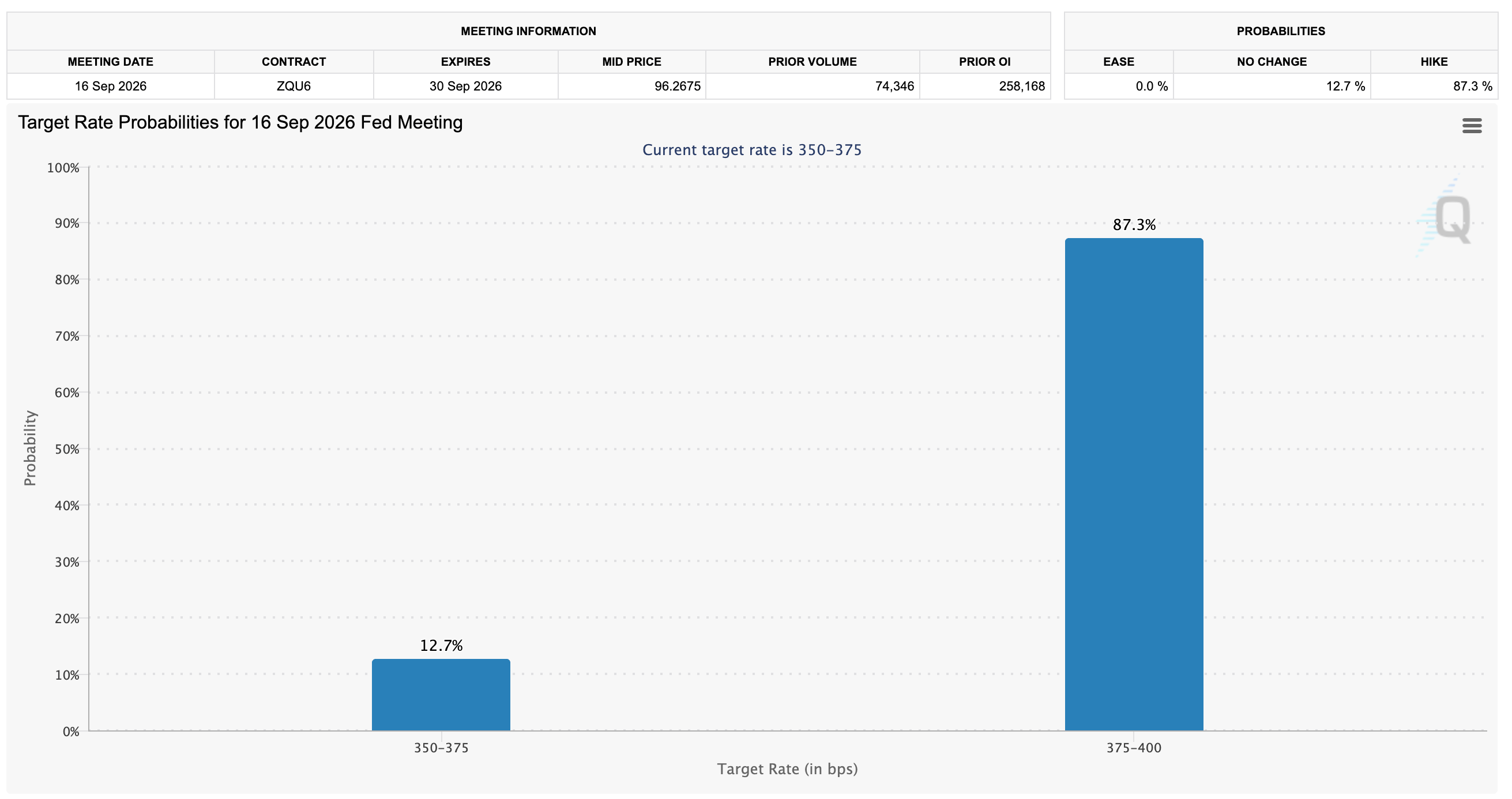
Friday’s CPI print served as formal confirmation of what fixed-income futures had already priced in during Thursday’s session. Ahead of the upcoming September 16 Fed meeting, the CME FedWatch pricing shifted decisively:
Thursday Session: Implied market probabilities stood at 72.4% for a 25 bps rate hike.
Friday Post-CPI: That probability jumped to 87.3% (target rate range 375–400 bps), with just a 12.7% chance of no change.
While market rumors continue to float the possibility of a jumbo 50 bps hike, we firmly disregard a 50 bps rate hike scenario. The repricing to 87.3% confirms that a measured 25 bps rate increase is the target the market is officially preparing for.
Crude Oil Above $100: The Market’s Energy Blind Spot
Adding fuel to global macro crosscurrents, front-month Crude Oil (CL) broke out forcefully this week, pushing past $104 per barrel.
Aside from Treasury futures which, as seen on the tape, move in sharp inverse correlation to inflationary pressure, broad equity markets seem to simply not care. Will the market ever care about triple-digit energy acting as an unannounced tax on corporate margins and consumer balance sheets? We don’t know. Nobody knows.
What we do know is that equity options continue to price risk as if energy-driven inflationary spikes can exist in a vacuum.
Earnings Non-Events and the Volatility Crush
On the single-stock front, Thursday afternoon brought earnings releases from Oracle (ORCL) and Adobe (ADBE). Both prints turned out to be relative non-events from a post-earnings dispersion standpoint.
The absence of sharp directional moves in ORCL and ADBE in addition to the slight intraday crush in Crude Oil combined with a modest post-CPI bid in Treasury futures contributed directly to this broader volatility smash, unwinding short-term systemic fear premium across macro and equity option chains that delivered a rapid, cross-asset volatility crush, generating immediate gains to option sellers:
Front-Month VIX Futures (VX): Closed Friday at 16.75, marking a sharp -1.38 drop from Thursday’s peak.
This sudden collapse in volatility demonstrates once again why systematic options execution relies on harvesting elevated Implied Volatility (IV) and IV Rank (IVR) ahead of binary events, allowing volatility normalization to work in favor of disciplined premium sellers.
Portfolio Execution & Risk Playbook
Duration & Contract Management: Holding our short ZB 108’00 put takes advantage of high extrinsic value post-selloff (with 14 DTE IV at 10.15%) without forcing an early roll into heavy delta exposure.
Equity Positions:
Vertiv Holdings (VRT) Put Ratio Spread (Buy 1, Sell 2):
Expiration & DTE: 16 OCT 26 (34 DTE)
Strikes: Buy 1 240 Put / Sell 2 230 Put
Execution Fill: $2.75 Net Credit
Entry Metrics: Delta 0.13, IV 56%, IVR 18, POP 82%
Netflix (NFLX) Short Put:
Expiration & DTE: 16 OCT 26 (34 DTE)
Strike: 75 Short Put
Execution Fill: $2.01 Net Credit
Entry Metrics: Delta 0.34, IV 35%, IVR 23, POP ~70%
Realized Gains & Portfolio Rotation: In addition to these core open positions, we closed several other equity and futures positions this past week, locking in gains between 10% and 30% return over very brief holding periods. Taking quick profits during volatile expansions keeps our portfolio agile and prevents unnecessary duration risk. (Full transaction trade logs and trade parameters are available in our archive).
Monetizing IV Crush: Non-event earnings in mega-cap tech (ORCL and ADBE), paired with a slight energy retreat and post-CPI bond stabilization, reinforce the mathematical edge of short premium strategies when volatility reaches temporary peaks.
Trade smart, Trade small.